
Why most PI firms are not financially ready for PE
Most personal injury law firms do not have a CFO. They have a bookkeeper, maybe a controller, and the founding partner who reviews the numbers when there is time. That works fine when the firm is a private practice. It does not work when private equity shows up.
The gap between what a founder-led firm produces financially and what institutional investors expect is significant. Closing that gap is exactly what an interim or fractional CFO does — and in the context of a law firm PE transaction, the CFO role is not a luxury. It is a necessity.
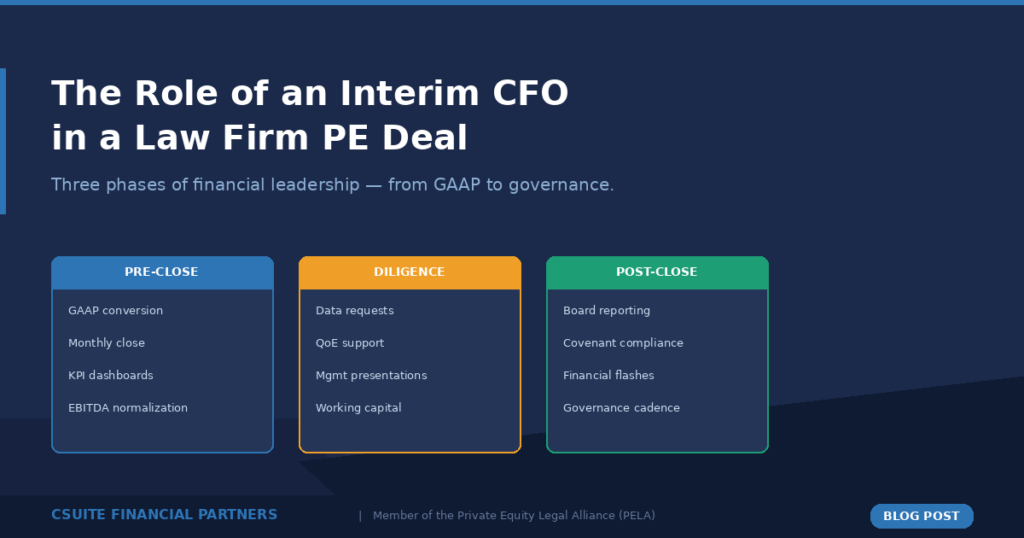
An interim CFO for a PI firm transaction typically works in three phases: pre-transaction preparation, active diligence support, and post-close financial operations.
Phase one: pre-transaction financial preparation
In the pre-transaction phase, the CFO’s first priority is converting the firm’s financials from cash-basis to GAAP accrual accounting. Most PI firms operate on cash basis because it is simpler and aligns with how they think about their business — money comes in when cases settle, money goes out when bills are paid. But private equity expects accrual-based reporting because it provides a more accurate picture of economic performance. Under GAAP, expenses are accrued as incurred even for ongoing cases, but revenue cannot be recognized until a case is resolved. This timing difference makes proper accrual accounting critical for contingency-fee firms.
The conversion rebuilds the chart of accounts to meet investor expectations. It implements a monthly close targeting ten to fifteen business days after month‑end. The process reconciles trust accounts, documents revenue recognition policies, and produces monthly income statements, balance sheets, and cash flow statements.
Building the case inventory model
Simultaneously, the CFO builds a case inventory model. Every open case is mapped with its sign date, current stage, expected policy limits, estimated net fee, probability of realization, and expected settlement date. Aggregated, this produces a Case Inventory Value — the firm’s forward revenue pipeline expressed in dollars. This model is one of the most important documents in any PI firm transaction because it gives investors confidence in future cash flows.
Normalizing EBITDA and establishing KPIs
The CFO normalizes the firm’s EBITDA. The CFO adjusts owner compensation to market rates, documents one‑time expenses, and separates personal expenses from operations. WE support each adjustment with documentation that withstands diligence scrutiny.
The CFO establishes and tracks key performance indicators. These include cost per signed case by marketing channel, lead‑to‑sign conversion, cycle time from sign to settlement, fee realization, operating cost per case, and marketing spend as a percentage of net fees. These KPIs form the foundation of the board‑level dashboards investors expect post‑close.
Phase two: active diligence support
During active diligence, the CFO serves as the primary financial point of contact for the buyer’s team. They field data requests, prepare management presentations, support the Quality of Earnings analysis, and help the founder navigate the financial complexity of the transaction — including working capital targets, earn-out mechanics, and the opening balance sheet.
Phase three: post-close financial operations
After close, the financial world changes overnight. The CFO ensures the firm meets new reporting obligations, including financial flashes within three to five days and full financials within fifteen days. The CFO also leads monthly sponsor meetings and quarterly board reviews covering KPIs, backlog, marketing performance, and growth initiatives. In the first year, some sponsors hold up to six board meetings to establish cadence.
Covenant compliance and lender reporting`
The CFO also manages covenant compliance. Most MSO deals involve leverage, and the lenders impose financial covenants including leverage ratio, interest coverage ratio, fixed-charge coverage ratio, and minimum liquidity requirements. Missing covenants can trigger interest rate penalties or increased lender oversight. Hitting them consistently builds credibility and optionality for future transactions.
When to bring in an interim CFO
At CSuite Financial Partners, this is our core competency. We embed as interim or fractional CFOs alongside founders and their teams throughout the transaction—from GAAP conversion to diligence to post‑close integration. Our work is fully embedded, with direct ownership of systems, reporting, and participation in key decision‑making forums.
If your firm is considering a PE transaction and you do not have a CFO, the time to bring one in is now — ideally twelve months before you plan to go to market. Financial preparation cannot be rushed, and the firms that invest in it early command better valuations, smoother diligence, and stronger post-close relationships with their investors.