
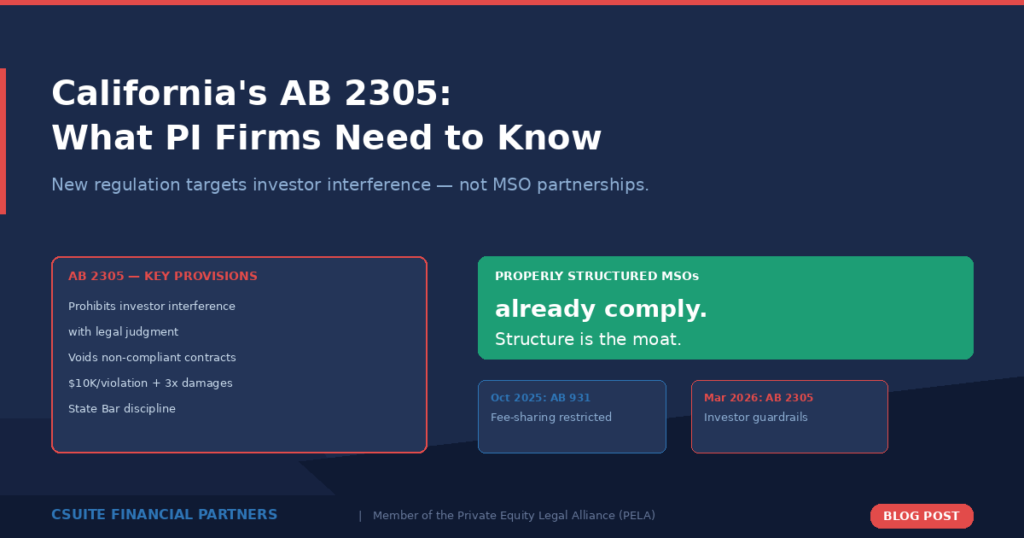
On March 16, 2026, California amended Assembly Bill 2305 to create one of the most comprehensive frameworks in the country regulating corporate investment in litigation practices. If you are a PI firm owner — in California or anywhere else — this legislation signals where the regulatory environment is heading.
What AB 2305 proposes
AB 2305 was originally a bill about lawyer referral services. The March amendment stripped that out entirely and replaced the substance with a new framework targeting corporate investors involved in litigation practices. The bill defines corporate investor broadly to include any private equity group, hedge fund, investment firm, or any non-attorney corporation with the primary purpose of raising or managing capital that participates in a litigation practice through an ownership, financing, or management arrangement.
Why PI firm owners are concerned about losing control
Recently we have been in touch with PI firm operators. The most common concern we hear is that founders are afraid of losing control of their firms. That fear is understandable. It reflects a legitimate anxiety about what happens when outside capital enters a profession built on professional independence.
How a properly structured MSO already addresses these concerns
But a properly structured MSO already addresses this concern. The law firm stays one hundred percent lawyer-owned. Attorneys retain full control over how they deliver legal services — which clients to take, case strategy, settlement decisions, everything. The MSO handles the business side: finance, marketing, HR, IT, intake.
What the bill specifically prohibits
What AB 2305 does is affirm what should already exist in any well-structured deal. The bill prohibits corporate investors from interfering with a licensed attorney’s professional judgment regarding substantive litigation decisions. It prohibits determining which clients to represent, the scope of representation, financial terms of client representation, legal strategy, whether to file or dismiss claims, settlement decisions, evidence presentation, discovery conduct, and appellate or procedural choices.
Contractual restrictions under AB 2305
The bill also targets contractual relationships. It prohibits any contract provision that would permit or facilitate investor interference with legal judgment. Any such provision is deemed void, unenforceable, and against public policy. Contracts cannot restrict an attorney from withdrawing in the event of corporate interference, prohibit an attorney from reporting interference to the State Bar, or impose financial penalties for reporting or resisting corporate influence.
Violations carry real teeth: statutory damages of ten thousand dollars per violation or three times actual damages, whichever is greater, plus attorney fees and injunctive relief. A violation also constitutes cause for State Bar discipline.
Strategic implications for PI firm owners
For PI firm owners evaluating MSO partnerships, the takeaway is nuanced. This bill does not ban MSOs. It does not ban PE investment in law firm infrastructure. It bans interference with legal judgment — which is exactly what a compliant MSO is designed to avoid.
Holland and Knight, which advises on more MSO transactions than any other firm in the country, noted that a well-structured MSO relationship that already respects attorney autonomy over professional decisions will likely be compliant with these proposed regulations.
The regulatory direction is clear
There are two strategic implications worth considering. First, early movers have an advantage. The regulatory window is tightening. Firms that structure MSO partnerships now, under current guidance, build on established ground. Firms that wait will navigate rules written by legislators who are paying increasingly close attention to this space.
Second, structure is the moat. If your MSO deal is built correctly — with the law firm retaining full control of legal decisions and the MSO confined to non-legal operations — this legislation is not a threat. It is a barrier to entry for competitors who come later with poorly structured deals.
This follows California’s AB 931 from October 2025, which restricted fee-sharing with out-of-state ABS attorneys. The direction is clear: more regulation, not less. The firms that prepare now will be positioned to operate within whatever framework emerges.
At CSuite Financial Partners, we help firms build the financial infrastructure that keeps the bright line clear between the business of law and the practice of law. The structure matters. The numbers behind it matter just as much.