

If you run a personal injury law firm and have started hearing the term “MSO,” you are not alone. Management Services Organizations have become the dominant structure for private equity investment in law firms, and understanding how they work is no longer optional for firm owners who want to stay competitive.
This guide breaks down the MSO model from a financial and operational perspective — not a legal one. At CSuite Financial Partners, we help PI firms build the financial infrastructure that makes MSO partnerships possible. Here is what you need to know.
What is a management services organization?
An MSO, or Management Services Organization, is a separate business entity that provides non-legal operational services to a law firm. The concept originated in healthcare, where regulations prevent non-physicians from owning medical practices. MSOs emerged as a compliant workaround: a separate company handles the business side while licensed professionals retain ownership and control of the clinical practice.
The same model now applies to law. Under ABA Model Rule 5.4, non-lawyers cannot own law firms or share in legal fees in most U.S. jurisdictions. The MSO structure respects that boundary by separating the business of law from the practice of law.
How a law firm MSO transaction works
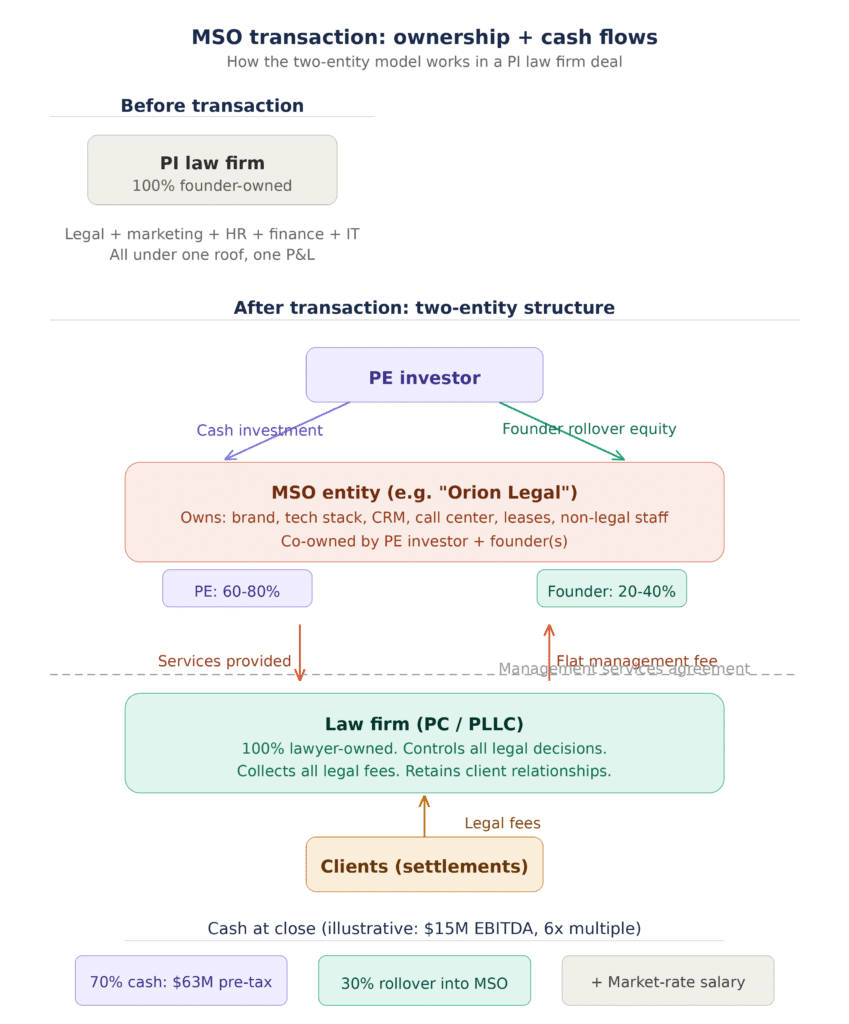
Before an MSO transaction, a PI law firm is a single entity. Legal practice, marketing, HR, finance, IT, and facilities all operate under one roof. The founder owns everything and takes home the firm’s entire profit through distributions.
An MSO transaction splits that single entity into two distinct companies.
The first entity is the law firm itself, organized as a PC or PLLC. It remains one hundred percent lawyer-owned. It retains all legal practice, client relationships, trust accounts, and attorney staff. The attorneys control which clients to take, case strategy, settlement decisions, and every aspect of legal service delivery. Nothing about the lawyer’s professional independence changes.
The second entity is the MSO. This is a separate operating company that owns and manages the non-legal business infrastructure. That includes the brand, technology stack, CRM, call center, office leases, marketing operations, and non-lawyer staff. The MSO is co-owned by the PE investor and the founding partners, who typically roll a portion of their equity into the MSO.
The management services agreement and fee structure
The two entities are connected by a Management Services Agreement, or MSA. This is the contractual backbone of the entire structure. Under the MSA, the MSO provides all non-legal services to the law firm in exchange for a management fee.
The management fee is where compliance matters most. The MSO cannot receive a percentage of legal revenue or profits. That would constitute fee-sharing under Rule 5.4 and is prohibited in most jurisdictions. The Texas Commission on Professional Ethics confirmed this in Opinion 706, issued in February 2025.
Instead, compliant fee structures include flat monthly or annual fees, cost-plus pricing where the firm reimburses the MSO for actual operating costs plus a predetermined margin, and tiered fees based on headcount or case volume. The fee must reflect fair market value and be documented against comparable market pricing.
What stays with the law firm and what moves to the MSO
L.E.K. Consulting published a detailed functional taxonomy in February 2026 that maps exactly which functions belong to the law firm and which move to the MSO. Legal delivery and professional judgment stay with the firm. Client relationships, trust accounts, and conflicts management stay with the firm. Everything else — marketing and intake, technology and data systems, finance and accounting, HR and recruiting, facilities and procurement — moves to the MSO.
MSO deals are already happening
This is not a theoretical framework. It is the operating model that real deals are being built on right now. Uplift Investors formed Orion Legal MSO with Dudley DeBosier Injury Lawyers in January 2026. Rimon PC’s MSO partnership with Alpine Investors through NovaLaw has been operating for over three years. Holland and Knight reports advising on more than forty live MSO transactions in 2026 alone.
Why the MSO model matters for PI firm owners
For PI firm owners, the MSO model matters because it creates a path to liquidity, succession, and scale that did not exist before. Historically, lawyers could only sell their firms to other lawyers or merge with other firms. The MSO changes that by making the business infrastructure investable without selling the legal practice.
But here is what most founders do not realize until it is too late: the MSO model only works when the financial infrastructure supports it. Investors need GAAP-compliant financials, normalized EBITDA, a case inventory model, clean monthly closes, and documented KPIs. Most PI firms do not have any of this.
How CSuite Financial Partners helps law firms prepare
That is where CSuite Financial Partners comes in. We embed alongside founders and their teams to build investor-grade finance functions, prepare for diligence, and guide firms through close and beyond. We have led more PI finance transformations than anyone in the U.S., and we are a founding member of the Private Equity Legal Alliance.
If you are exploring an MSO structure for your firm, the first step is getting your financial house in order. The structure is only as strong as the numbers behind it.